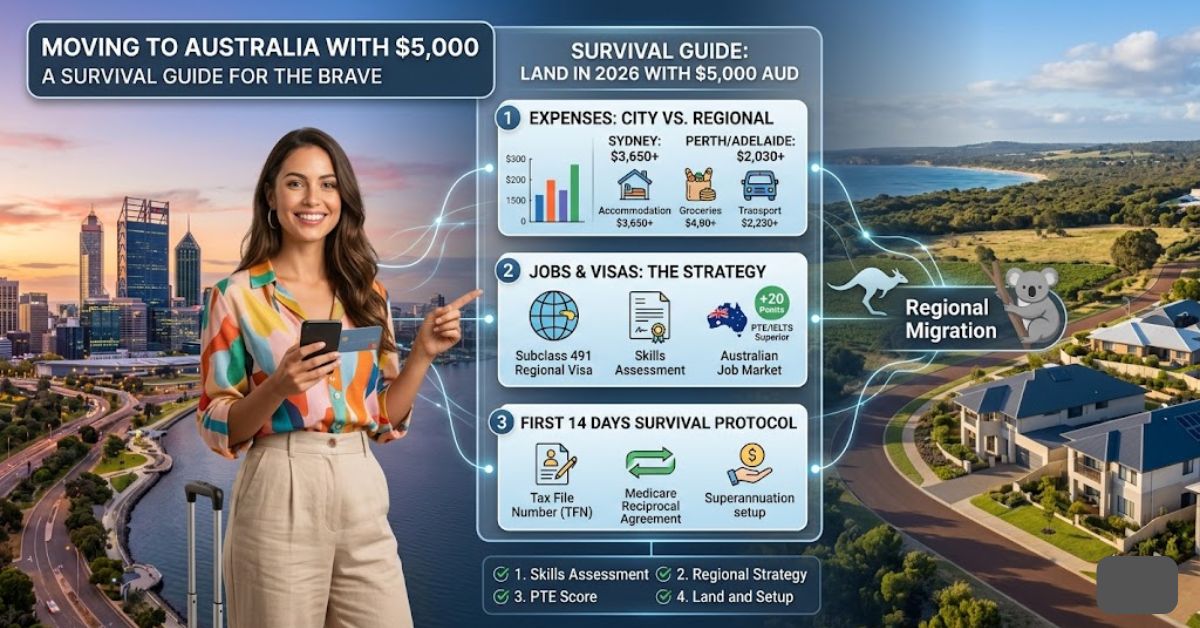
Moving to Australia with $5,000: A Survival Guide for the Brave
Let’s be brutally honest: moving to Australia in 2026 with only $5,000 AUD in your pocket is a gamble. It’s a high-stakes move that most safe migration agents would tell you is impossible. But here’s the reality: with the right strategy, a sharp focus on Regional Migration Australia, and a bit of grit, that $5,000 can be the seed money for your new life Down Under.
If you are staring at your bank balance and wondering if you can actually leap Sydney, Melbourne, or the Outback, you’ve landed in the right place. This isn’t a dry corporate brochure; it’s a 2026 survival guide for the bold. We’re going to break down how to stretch your initial settlement funds, bypass the expensive city traps, and secure a spot in the Australian Job Market before your last dollar disappears.
1. The Reality Check Australia’s 2026 Cost Landscape
Let’s not sugarcoat it: Australia is a stunning place to live, but it’s a paradise that will bleed your wallet dry if you aren’t careful. By mid 2026, even with inflation finally taking a backseat, the Cost of Living Australia 2026 figures hit like a ton of bricks. The savage reality? Housing remains a total money-muncher that destroys most budgets.
If you make the rookie mistake of landing in Sydney with just $5,000, you’ll be staring at a zero balance and checking flight prices back home within three weeks. Seriously. However, if you’re smart and pivot to the Subclass 491 Regional Visa, targeting hubs like Adelaide, Perth, or regional Queensland, your financial survival time literally doubles.
First Month Expense Breakdown (The Budget Battle):
| Expense Item (First Month) | Sydney/Melbourne (The Burn Zone) | Regional Hubs (The Safety Net) |
| Accommodation Bond (4 Weeks) | $2,800 – $3,500 | $1,400 – $1,800 |
| Groceries & Basic Survival | $600 | $450 |
| Transport (Public/Fuel) | $250 | $180 |
| TFN / Medicare / Admin | $0 (Don’t pay a cent for these!) | $0 (Always Free) |
| Total Startup Burn | $3,650+ | $2,030+ |
The Verdict: In 2026, regional migration isn’t just a smart strategy; it’s a non negotiable survival tactic for anyone landing with a tight $5,000 limit. If you actually want to survive the first year, stay the hell away from the big city traps for at least your first 90 days.
2. Visa Strategy: The Budget Friendly Pathways
Look, let’s be brutally honest: you aren’t earning a single Australian Dollar without a bulletproof paper trail. While everyone dreams of the Subclass 189 Independent Visa, the reality in 2026 is that it’s a total bloodbath for most applicants. If you’re on a tight budget, chasing the 189 is basically throwing your money into a black hole. Your real “VIP entry” lies in the Subclass 190 Visa (State Nominated) or the Subclass 491. These aren’t just backup plans; they are the fastest routes because regional Australia is literally begging for specific skills right now.
The Skill Based Shortcut
Before you even dream of booking that one way flight, you’ve got to clear the Skills Assessment Australia hurdle. Think of this as your golden ticket. Whether you’re dealing with VETASSESS, Engineers Australia, or AHPRA, getting your credentials stamped is 100% non-negotiable. If you try to skip this or wing it, your Australian dream is dead on arrival.
The 2026 Strategy Note: The smart crowd in 2026 isn’t just applying and praying. They are dissecting the Skilled Occupation List (SOL) and using the Points Test Calculator like a weapon to find the exact sweet spot that triggers an automatic invitation.
Pro Tip: Gaming the Points System. Don’t be a just passed applicant. You need to crush the PTE Academic or IELTS Score to get that Superior rating. In 2026, English Language Proficiency isn’t just about ordering a coffee; it’s about snatching those 20 extra points. Those points are the difference between a successful Expression of Interest (EOI) and one that sits in the database gathering virtual dust for two years.
3. The First 14 Days Survival Protocol
The second you clear customs and step out of the airport, your burn rate officially begins. With only $5,000 in the bank, you don’t have the luxury of figuring it out as you go. To stop your savings from evaporating, you need to execute these three high-priority moves within your first 72 hours on Aussie soil:
Step 1: The TFN Lockdown
Don’t wait. Get your Tax File Number (TFN) sorted the very first morning. You physically cannot get paid a legal wage in the Australian Labor Market without this little number. Applying online is 100% free, and the Department of Home Affairs expects you to have this ready before you even look at a job board. If you work off the books, you’re asking for trouble.
Step 2: Don’t Ignore Your Superannuation
This is a mistake most newbies make. Even if you’re on a Bridging Visa or a temporary permit, your employer is legally required to pay into your Superannuation (your retirement fund). This is your money, effectively a 11.5% bonus on top of your salary. Set up your Super account on day one so your contributions don’t get lost in some generic government clearing house.
Step 3: The Medicare Reality Check
Health costs in Australia will bankrupt you faster than rent. Check immediately if your home country has a Reciprocal Health Care Agreement for Medicare. If you aren’t covered, get a basic private health policy instantly. One unexpected trip to the ER will wipe out your entire $5,000 survival fund in a single night. Don’t gamble with your health when your budget is this tight.
4. Hacking the Australian Job Market
In 2026, the Hidden Job Market is where the deals happen. Don’t just rely on Seek or LinkedIn.
- Casual Filler Jobs: Look for Work for Accommodation in regional hostels or fruit picking in the Murray Valley. It keeps your $5,000 intact while you wait for a professional role.
- The Medicare Trap: Remember, as a new arrival, you likely won’t have Centrelink Eligibility. You are on your own, which means your first job doesn’t have to be your dream job; it just needs to pay the rent.
- Regional Advantage: Many regional employers offer Relocation Incentives. If you’re a nurse, mechanic, or teacher, regional councils might actually reimburse some of your move costs.
5. Housing: Avoiding the Bond Trap
Let’s be blunt: your biggest financial enemy in Australia isn’t the price of coffee, it’s the Accommodation Bond. In 2026, landlords and agents typically demand four weeks of rent upfront to be held by the state government. If you’re trying to survive on a $5,000 budget, handing over $2,500 in one go is a death sentence for your cash flow.
The Survival Hack: Think Outside the Studio. Don’t even look at private apartments initially. Head straight to Flatmates.com.au or local Facebook groups to find Share Houses. Look for all bills included setups where the bond might only be two weeks instead of four. This keeps your liquid cash available for emergencies while you hunt for a job in the Australian Job Market.
The Avoid at All Costs Rule: Stay far away from short-term Airbnbs or hotels in the city center. They will bleed your account dry in less than a week. A cheap Airbnb in Sydney or Melbourne can easily cost you $150 a night; do the math, and you’ll see your $5,000 vanishing before you even get your TFN in the mail. Look for a suburban share-room where you can hunker down for $250 a week instead.
6. FAQ: Brutal Truths About the Move
Q: Can I apply for Australian Permanent Residency (PR) with only $5,000?
A: The move costs $5,000, but the visa fees, medicals, and Skills Assessment usually cost another $4,000–$7,000 beforehand. This $5,000 is your landing fund, not your total migration cost.
Q: Is it hard to find a job on a Bridging Visa?
A: Some employers are hesitant, but in the current Australian Labor Market, skill shortages are so high that most will hire you if your Right to Work check is clear.
Q: Should I buy a car immediately?
A: No. Use public transport. A $2,000 car in Australia is usually a $2,000 headache in repairs. Wait until you have your first three months of payslips.
Final Verdict: Can You Do It?
Moving to Australia with $5,000 is a Digital Chess Match. You have to play every move perfectly. Target regional areas, lock in your English Language Proficiency scores, and don’t be too proud to take a survival job while your PR processes.
The Kingdom err, the Commonwealth is moving fast. If you stay sharp, keep your paperwork tight, and stay out of the big cities initially, that $5,000 can be the best investment you ever make.
Disclaimer :
I’m not a migration agent or a legal pro, so don’t take this as gospel. The Australian market is a fast moving beast in 2026, and since visa policies change faster than the weather in Melbourne, you should always double check the Department of Home Affairs site. This guide is here to give you an edge, but at the end of the day, your money and your move are your own responsibility