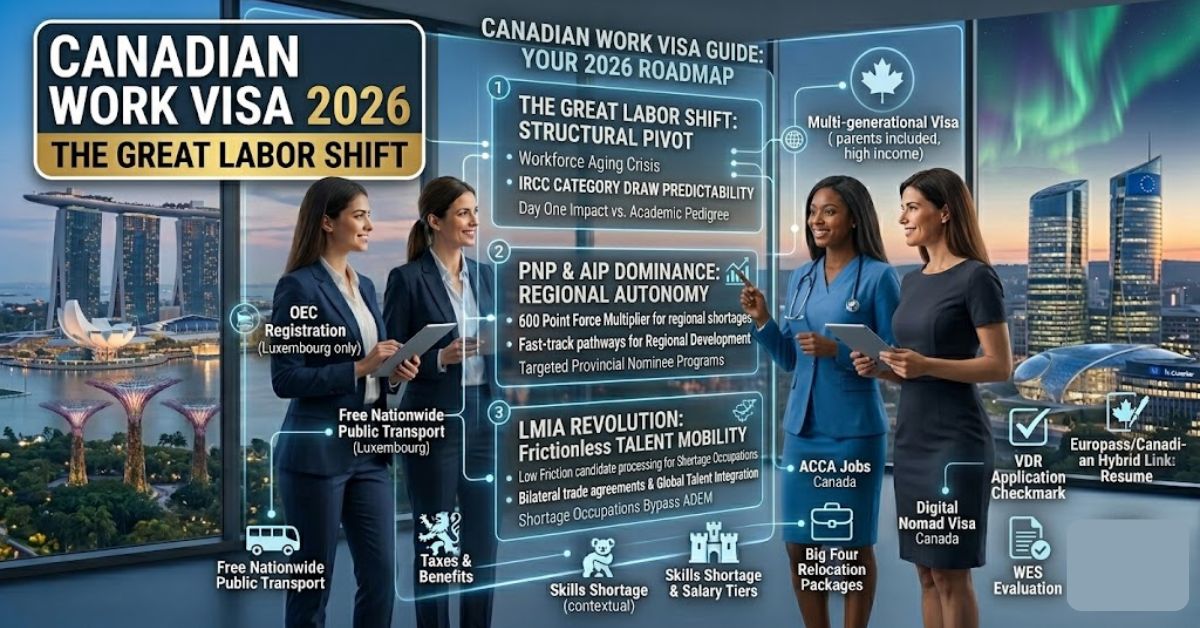
Why 2026 is the Best Year to Apply for a Canadian Work Visa: The Great Labor Shift
Let’s be blunt: the No Canadian Experience barrier was never just a requirement it was a bureaucratic filter that turned world-class talent into overqualified Uber drivers. For far too long, the system prioritized paper heavy pedigree while ignoring the boots on the ground” expertise that actually builds a nation. But the 2026 economic crunch has changed the game. Canada’s hand has been forced. The old drawbridge hasn’t just been lowered; the entire gate is being redesigned. What we are seeing is a massive, high-velocity pivot where the Great White North is scrapping its one size fits all mindset for a surgical approach: Targeted Recruitment and Skills Based Hiring.
This isn’t some surface level PR move; it’s a total systemic reboot. Under the Canada Immigration Levels Plan 2026, the IRCC has traded academic theory for raw economic utility. They’ve stopped just collecting resumes and started measuring Day One impact. Whether you’re a veteran industrial welder, a cloud native software architect, or a front-line specialist nurse, the 2026 window is a historic fluke in the immigration timeline. Canada has moved past the era of simply granting visas; it is now aggressively headhunting for the specific DNA its economy needs to survive the next decade.
1. The 2026 Structural Pivot: Capitalizing on the Demographic Cliff
Let’s look at the cold, hard numbers: Canada is currently staring down a Workforce Aging Crisis that has officially hit a critical tipping point. As we move through 2026, a massive wave of the Baby Boomer generation is exiting the labor market for retirement, leaving a gaping hole in the national tax base. For the first time in decades, the Canadian government isn’t just looking for immigrants they are desperate for Specialized Talent Acquisition to prevent an economic slowdown.
The real game-changer in 2026 is how the IRCC is shredding the old bureaucratic playbook. They are now bypassing the traditional General Pool chaos in favor of Category Based Express Entry Draws. Previously, a veteran electrician or a specialized nurse would lose out to a 22 year old student with a high IELTS score. That era is over. Now, you are only competing within your Specific Professional Niche, making the path to PR significantly more predictable for actual experts.
High Impact Sectors: Where the 2026 Opportunities Live
| Occupational Sector | The Ground Level Demand Driver | Strategic 2026 Entry Path |
| Healthcare & Social Care | A historic demographic shift towards elder care. | Healthcare Workforce Shortage priority draws. |
| Tech, AI & Cybersecurity | National mandates for Digital Sovereignty. | Dedicated STEM Occupations Draw (Fast-track). |
| Skilled Trades & Infrastructure | The 2026 Federal Housing Supply Mandate. | Focus on In Demand Skilled Trades (Red Seal). |
| Logistics & Supply Chain | Pivot toward autonomous and global e-commerce. | Expanded TEER Categories for supply ops. |
2. Navigating the 2026 Roadmap: The Great PNP Dominance
If you’re still hyper-focused on the Federal Express Entry pool, you’re playing an outdated game. In 2026, the real Market Arbitrage lies in the Provincial Nominee Programs (PNP). These programs have evolved from mere secondary backups into the dominant engine of Canadian immigration. While the Federal pool remains crowded, the provinces are now operating with unprecedented autonomy to hand pick talent.
The Rise of Provincial Autonomy
Provinces like Ontario (OINP), Alberta (AAIP), and British Columbia (BCPNP) are no longer waiting for the federal government to set the tone. They now function under Targeted Recruitment 2026 mandates. The secret? If your professional profile aligns with a specific regional shortage, a Provincial Nomination essentially force multiplies your application, granting you 600 points and a near- guaranteed invitation for Permanent Residency (PR), regardless of how low your initial CRS score might be.
- Atlantic Immigration Program (AIP): Still the undisputed champion for Employer-Driven migration. It’s the most efficient route for those targeting the East Coast, specifically designed with more accessible language (CLB) and financial settlement thresholds.
- Rural and Northern Immigration Pilot (RNIP): Transitioning into a permanent pillar in 2026, this program is a goldmine for those seeking a Lifestyle Arbitrage. It targets smaller, high growth communities where the Cost of Living doesn’t eat up your entire paycheck, unlike the saturated markets of Toronto or Vancouver.
- Critical Worker Pilot: This is the 2026 Social Equity path. It’s built specifically for Essential Roles (TEER 4-5) the backbone of the economy that was historically ignored by high points systems but is now the top priority for regional labor stability.
3. The LMIA Revolution Killing the Administrative Red Tape
Let’s be real: for years, the LMIA (Labour Market Impact Assessment) was the ultimate Deal Breaker for anyone trying to land a Canadian job from abroad. It wasn’t just a simple form; it was a grueling, multi-month bureaucratic nightmare. Employers were essentially forced to prove beyond any reasonable doubt that no local Canadian could do the job. For many SMEs (Small and Medium Enterprises), this administrative bottleneck was simply too expensive, slow, and risky to bother with. However, 2026 has brought a massive expansion of LMIA Exemptions, fundamentally rewriting the rules of the game.
The Era of Frictionless Talent Mobility
Thanks to a combination of aggressive Employer Driven Sponsorship models and newly ratified bilateral trade agreements, the outdated Proof of Shortage requirement is being waived for a vast array of technical and essential sectors. In 2026, if your profession falls under a designated Shortage Occupation, you effectively become a Low Friction candidate.
This is a strategic win-win. Canadian firms can now bypass the old Protectionist Red Tape to plug their 2026 Operational Gaps without delay. For you, the applicant, this means the path to a work permit is no longer blocked by the agonizing, six month wait for a positive assessment. We are moving from Protectionist Hiring to a model of Global Talent Integration, making 2026 the smoothest year on record for direct, employer-led recruitment.
4. The Inside Track CEC and the PGWP 2.0 Paradigm
For anyone currently navigating life within Canada or eyeing a study permit-to-PR pipeline, the Canadian Experience Class (CEC) continues to hold its crown as the most reliable pathway. But the true game changer in 2026 is the PGWP 2.0 Modernization. After years of advocacy, the federal framework has finally eliminated the status limbo that haunted international graduates. These 2026 reforms ensure a seamless bridge, allowing those with local academic and economic contributions to maintain their Right to Work without interruption while their Permanent Residency (PR) files are being adjudicated.
The Digital Nomad Soft Landing Strategy
While the student route is a classic, the Digital Nomad Visa Canada has emerged in 2026 as the ultimate sophisticated entry point. This isn’t just a perk for backpackers anymore; it’s a strategic Soft Landing framework. Savvy remote professionals are now using this status to establish residency while retaining their global salaries, giving them the financial runway to build genuine local industry connections. The result? A stress-free transition into a Targeted Recruitment work permit once a local offer is secured—eliminating the costly and outdated “Flagpoling” or international exits to reset legal status.
5. Technical Hooks Mastering the TEER Language
If you want to succeed in the 2026 landscape, you have to stop thinking in terms of generic job titles and start speaking the IRCC’s technical dialect. Your eligibility for a work visa is no longer just about what you call yourself; it is strictly governed by your TEER Category (Training, Education, Experience, and Responsibilities). Understanding where you sit on this spectrum is the difference between a rejected application and a successful nomination.
The 2026 TEER Hierarchy: Where Do You Fit?
To navigate the 2026 shift, you need to identify which bracket your expertise falls into, as each has a distinct strategic entry point:
- TEER 0-1 (The Specialized Elite): These are Management and Professional roles requiring university degrees. In 2026, this is the primary territory for STEM Architects and Healthcare Specialists. If you are in this bracket, your path is almost always through high-priority, category based draws.
- TEER 2-3 (The 2026 Sweet Spot): This category covers Technical occupations and Skilled Trades requiring college diplomas or specialized apprenticeship training. This is where the labor supply demand gap is at its widest. Whether it’s specialized welding or HVAC systems, TEER 2-3 applicants are currently the most headhunted demographic in Canada.
- TEER 4-5 (The Essential Backbone): Covering essential labor and intermediate occupations, these roles were once overlooked. In 2026, they are the heartbeat of the Critical Worker Pilot and various regional development initiatives, offering a pathway for those with practical, foundational experience.
6. FAQ: Real World Realities of the 2026 Move
Q: Is the Trade Skills Shortage just a political talking point?
A: No. It is an actuarial reality. With over 800,000 vacancies projected in infrastructure and healthcare by the end of 2026, the shortage is structural. Canada does not have enough local youth entering these fields to meet its 2026-2030 development goals.
Q: Can I apply if I don’t have a Canadian Job Offer?
A: Yes. While Employer-Sponsored visas are faster, many Category Based Draws and PNPs are specifically designed to invite people based on their Human Capital (skills and age) rather than an active contract.
Q: Which province is the Easiest in 2026?
A: Easy is relative to your skill. However, the Atlantic Immigration Program (AIP) provinces (Nova Scotia, NB, PEI) currently offer the most flexible criteria for those without high level academic degrees.
Final Verdict: The Early Bird Advantage
The Canada Immigration Levels Plan 2026 is a massive, historic green light. However, market equilibrium suggests that as more people realize how accessible the drawbridge has become, the CRS requirements for targeted draws will eventually tighten.
By initiating your WES evaluation, preparing for IELTS/CELPIP, and Canadianizing your resume into the Europass/Canadian Hybrid format now, you position yourself as a first mover in a high reward market. 2026 isn’t just about moving; it’s about claiming your seat at the table of a G7 economy before the window stabilizes.
Disclaimer :
This analysis is an editorial roadmap based on the 2026 Canadian labor climate and should not be treated as formal legal advice. While our insights reflect current IRCC operational shifts, final visa issuance is strictly contingent upon individual merit and evolving federal directives. Always verify the latest financial and eligibility requirements through official Government of Canada portals before making any relocation investments.