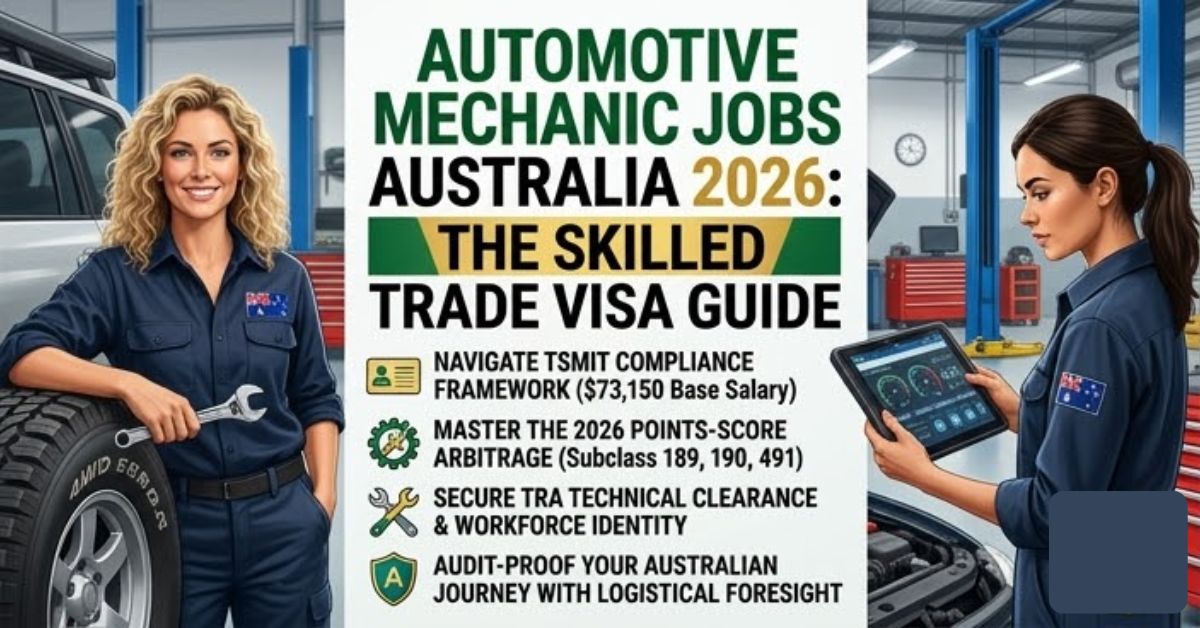
Automotive Mechanic Jobs Australia 2026: The Skilled Trade Visa Guide
Navigating the Australian automotive sector in 2026 has fundamentally morphed from a simple job hunt into a high-stakes Technical Compliance Journey. As the Australian government recalibrates the Medium and Long term Strategic Skills List (MLTSSL), the Apply and Hope strategy is officially obsolete. To secure a seat in an Australian workshop, you must transition from a traditional mechanic into a tactical specialist who understands TRA Skills Assessments and Subclass 482 sponsorship better than the recruiters themselves.
Whether you are a Light Vehicle expert or a Diesel specialist, this roadmap is engineered to out maneuver the administrative backlogs and points test volatility currently clogging the system. Executing your Australian transition with logistical foresight, backed by a Verified Trade Sponsorship Database, is the only definitive way to convert a temporary offer into a permanent, high-performance career legacy.
1. Fiscal Guardrails: Navigating the 2026 TSMIT Compliance Framework
In the 2026 Australian labor market, the most frequent point of failure for visa applicants is no longer a lack of technical proficiency, but rather a strategic mismatch with the Temporary Skilled Migration Income Threshold (TSMIT). Following the massive overhaul of the Skilled Trade Migration Roadmap, any remuneration package that undercuts the statutory minimum now triggers an automatic, system-generated audit. To insulate your professional future, you must authenticate your potential employer’s Standard Business Sponsor (SBS) credentials long before the first tool is picked up in the workshop.
2026 Australia Workforce Compliance Table
| Compliance Metric | 2026 Operational Benchmark | Strategic PR Impact |
| Statutory Floor | AUD $73,150 (Base Salary) | Non-Negotiable Threshold |
| Compulsory Super | 11.5% Employer Share | Statutory Entitlement |
| Trade Verification | TRA Skills Assessment | Critical PR Catalyst |
| ANZSCO Classification | 321111 (Motor Mechanic) | Priority MLTSSL Listing |
| English Proficiency | PTE 50+ / IELTS 6.0 | Baseline Entry Requirement |
Tactical Pro Tip: Don’t just trust the contract; verify the Annual Market Salary Rate (AMSR) via the Fair Work Australia database. If your proposed salary for a role like a Diesel Motor Mechanic or Automotive Electrician deviates from the regional benchmark, the Department of Home Affairs will likely flag your Subclass 482 petition for Systemic Non Compliance, effectively freezing your migration journey.
2. Operational Landing Zones: Mastering the 2026 Point-Score Arbitrage
In the current 2026 migration cycle, the Australian Department of Home Affairs has aggressively prioritized Regional Australia Labour Agreements over saturated metropolitan markets. While Tier-1 cities like Sydney face immense points inflation, the true Operational Shortcut is currently found in the resource heavy sectors of Western Australia (WA) and Queensland (QLD). For an Automotive Mechanic, landing a high yield role in the Mining Sector often serves as the fastest catalyst for permanent status.
To dominate this landscape, you must deploy one of these three strategic visa maneuvers:
- Subclass 189 (Skilled Independent): Operates as a pure Meritocracy Lane. It requires zero employer intervention but demands an elite-tier performance on the 2026 Points Test. In today’s climate, this is reserved for perfect profile candidates with maximum scores in age, linguistic proficiency, and global trade experience.
- Subclass 190 (Skilled Nominated): Functioning as a state sponsored Priority Corridor, this subclass provides an immediate bridge to PR status. It is the tactical choice for mechanics targeting high demand industrial hubs in NSW or Victoria, where specific state-nomination criteria often override generic federal queues.
- Subclass 491 (Skilled Work Regional): The highest velocity Tactical Entry point of 2026. By committing to a designated regional zone for a 3-year stint, you secure a definitive PR Pathway for Motor Mechanics. With significantly lower points thresholds than the 189/190 streams, this remains the most pragmatic route for offshore technical talent.
3. The Vetting Protocol: TRA Technical Clearance & Workforce Identity
In the current 2026 landscape, Trades Recognition Australia (TRA) has fully operationalized an aggressive verification protocol that moves beyond simple paperwork. Your professional dossier must now function as objective, forensic proof of your status as a Highly Skilled asset. The vetting mechanism has fundamentally morphed into a high stakes investigation of your Workforce Identity, requiring two critical operational layers:
- The 2026 Credential Authenticity Sweep: To eliminate the industry Trust Gap, all experience letters and trade certificates are now cross-referenced against global industrial data hubs. This is designed specifically to detect AI-generated or synthetic work histories. To survive this technical audit, your Professional Footprint must be undeniable backed exclusively by verifiable, human-led milestones and real world workshop evidence.
- Hybrid & EV Specialization (The Fast-Track): To bridge the critical 2026 Green Skills Gap, candidates possessing Hybrid and Electric Vehicle (EV) Diagnostics certifications are receiving priority processing. This specialized technical expertise satisfies the officer’s increased vetting rigor and, in the current market, often commands a 20% salary premium over standard internal combustion engine (ICE) roles.
4. Procedural Sovereignty: Audit-Proofing Your Australian Journey
Dominating the 2026 Australian migration cycle requires more than just mechanical talent; it demands a ruthless adherence to a verified procedural sequence. In this high stakes ecosystem, even a microscopic discrepancy in your LMT (Labour Market Testing) logs or base salary disclosures can effectively paralyze your file for years. To secure your visa grant, you must execute these three high-priority operational milestones:
- Technical Credentialing (The TRA Foundation): You must finalize your TRA Stage 1 (Documentary Audit) and Stage 2 (Technical Interview/Practical) at least 6 months before your intended mobilization. This provides a critical buffer against 2026 processing spikes, ensuring your Workforce Identity is fully authenticated before any Department of Home Affairs intervention.
- Strategic EOI Deployment: Submit your professional credentials via the SkillSelect portal. It is vital to ensure that the points claimed for age, trade experience, and linguistic proficiency (PTE/IELTS) are forensicly accurate. In 2026, even a 5 point inflation can trigger a Integrity Bypass ban, permanently blacklisting your profile from future invitation rounds.
- LMT Compliance Verification: If your pathway involves a Subclass 482, you must confirm your employer has advertised the position locally for a minimum of 28 days. This must be executed in strict alignment with Fair Work Australia mandates to demonstrate no local labor displacement a primary focus of 2026 workforce audits.
5. FAQ: Australia Trade Migration Operational Intelligence
Q: Does the 2026 framework facilitate a direct transition from Subclass 482 to Permanent Residency?
A: Absolutely. Under the current 2026 Migration Strategy, the majority of Subclass 482 holders are eligible for a streamlined PR transition via the Employer Nomination Scheme (Subclass 186). The operational requirement has been optimized to just 2 years of verified service with the same sponsoring entity, provided all health and character benchmarks are maintained.
Q: Is the Diesel Motor Mechanic specialization currently outpacing General Mechanic in demand?
A: Correct. While both roles are on the priority list, the Diesel Motor Mechanic designation is currently classified under “Critical Structural Shortage,” particularly within the Mining Sector (WA/QLD). This high demand status often triggers accelerated state nomination invites and significantly lower points thresholds compared to urban automotive roles.
Q: What exactly is the TSMIT, and how does it impact visa security?
A: The Temporary Skilled Migration Income Threshold (TSMIT) functions as the mandatory fiscal floor for all sponsored talent. As of 2026, this benchmark is locked at AUD $73,150. Any remuneration package that fails to meet this specific figure is considered a Compliance Tripwire, leading to the immediate and automatic rejection of the visa petition.
Conclusion: Anchoring Your Australian Legacy
By 2026, success within the Australian Skilled Trade landscape has fundamentally decoupled from luck; it is now an objective result of executing a high level strategic roadmap that prioritizes Administrative Resilience. By aligning your professional trajectory with Approved Work Sponsors (SBS) and leveraging TRA Technical Data to your advantage, you aren’t merely securing a contract; you are architecting a high performance lifestyle in the world’s most resilient economy. In the current migration climate, those who command the technicalities of the 2026 workforce mandates are the ones who convert temporary sponsorship into a permanent, generational legacy.
Disclaimer:
This operational briefing functions as a raw strategic intelligence framework and operates entirely outside the jurisdiction of formal legal or immigration advocacy. All 2026 TSMIT benchmarks and Home Affairs filing thresholds remain vulnerable to instantaneous, high stakes recalibration dictated by shifting federal mandates. To ensure absolute synchronization with the latest workforce compliance protocols, you must authenticate your professional dossier via official Department of Home Affairs gateways prior to execution.