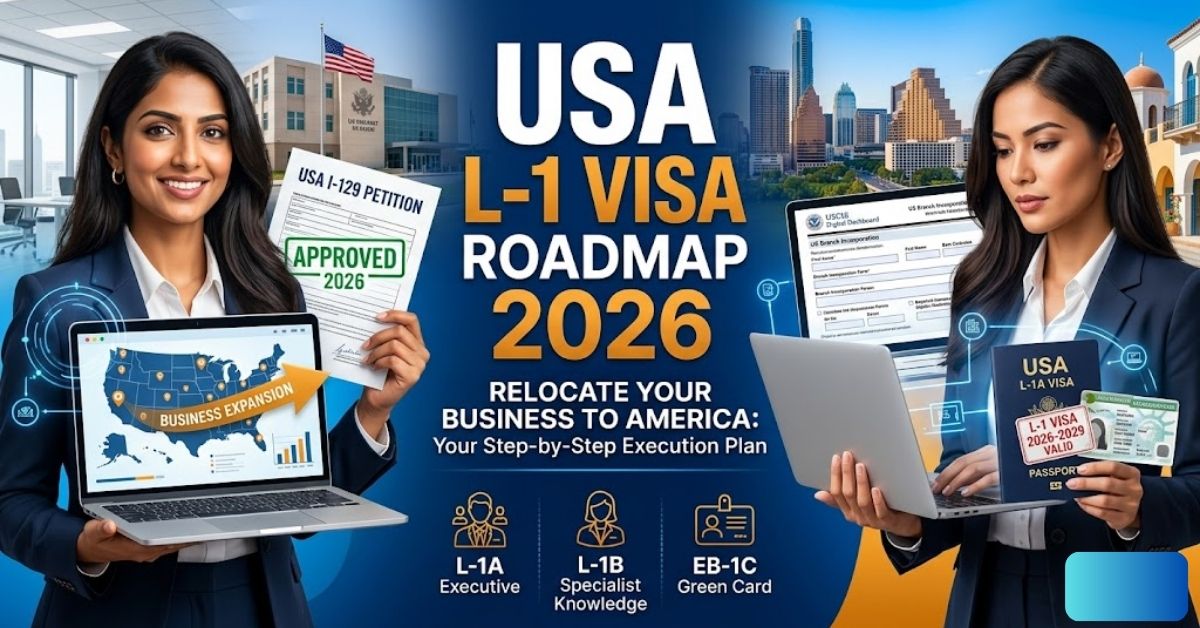
USA L-1 Visa Roadmap 2026: Relocate Your Business to America
Are you a visionary entrepreneur or a corporate leader looking to scale your operations in the world’s largest economy? In 2026, the USA L-1 Visa Roadmap has become the gold standard for global business expansion. Whether you are an L-1A Executive Transferee or possess L-1B Specialized Knowledge, the door to American markets is wider than ever, provided you have a surgical execution plan.
Relocating your business to the United States isn’t just about a change of scenery; it’s a high stakes move that requires a deep dive into USCIS Form I-129 protocols and a Substantial US Business Presence. This guide cuts through the bureaucratic noise to show you exactly how to launch your US Subsidiary Incorporation and secure your future on American soil.
1. Decoding the L-1 Visa: A Dual Intent Powerhouse
Unlike many restrictive or temporary only visa categories, the L-1 stands out as a genuine Dual Intent powerhouse. This is a critical distinction for 2026: it means you can legally work toward permanent residency via the L-1 to EB-1C Green Card Path while simultaneously managing your US operations. You aren’t just a guest; you are building a future.
L-1A vs. L-1B: Identifying Your Specific Pathway
Choosing the right stream is the first step in your USA L-1 Visa Roadmap. The USCIS looks for specific Capacity markers to approve these petitions:
- L-1A Executive/Manager: This is tailor-made for leaders with the Executive Capacity to make wide reaching corporate decisions or manage essential business functions. It’s about high level oversight, not daily administrative tasks.
- L-1B Specialized Knowledge: This category is for professionals who hold Proprietary Knowledge of the company’s specific products, internal systems, or international equipment. If your expertise is Advanced and unique to your organization, this is your entry point.
2. Eligibility & The Qualified Relationship
To pull off a New Office L-1 Petition, your foreign company and the new US branch must share a Qualified Entity Relationship (Subsidiary, Branch, or Affiliate). In 2026, the Qualifying Foreign Organization must continue to operate and do business during the entire stay of the L-1 holder in the USA.
2026 Financial & Salary Benchmarks
While there is no fixed L-1 Visa Minimum Investment 2026, your Business Plan for L-1 Visa must prove that the US entity can support an executive salary and operations within its first year.
| Feature | L-1A Executive / Manager | L-1B Specialized Knowledge |
| Initial Stay | 1 Year (New Office) / 3 Years | 3 Years |
| Max Limit | 7 Years Total | 5 Years Total |
| Green Card Path | Direct EB-1C (No PERM) | Requires Labor Certification |
| L-1 Visa Salary 2026 | Approx. $85k – $150k+ | Market Competitive Rates |
| Managerial Role | Managing People or Functions | Expert in Systems/IP |
3. The New Office L-1 Petition: A Step by Step Execution
If you are Opening a US Branch Office from scratch in 2026, the requirements are incredibly specific. You aren’t just relocating a person; you are proving to the US government your concrete intent to build a legitimate American workforce. This requires a three step tactical approach:
Step 1: Strategic US Subsidiary Incorporation
The first move is choosing your base of operations wisely. While the Best US States for L-1 Business often include traditional tech hubs like California or Texas, we are seeing a massive shift in 2026. Many savvy entrepreneurs are now moving toward Tax-Friendly States for US Subsidiaries, such as Florida or Wyoming, to maximize their initial ROI and reduce overhead during the startup phase.
Step 2: Securing Physical Premises (No Virtual Offices)
In 2026, the USCIS has doubled down on its Zero Tolerance policy regarding virtual offices or PO boxes for L-1 petitions. To pass this audit, you must provide a fully signed lease for a physical commercial space. This office must be Ready to Occupy and large enough to accommodate your projected US team as outlined in your business plan.
Step 3: Filing the USCIS Form I-129 & Fast-Tracking
This is where the Intracompany Transferee Visa process officially hits the desk of a high-stakes officer. Given the current 2026 backlogs, the Premium Processing Fee USCIS (currently $2,805) is no longer just an option it’s a necessity. This ensures a response within 15 calendar days, allowing you to bypass the standard 4-6 month waiting period and launch your American operations on schedule.
4. Family First: The Strategic L-2S Advantage
One of the most compelling reasons to choose the L-1 pathway in 2026 is the massive benefit provided to your immediate family. The L-2 Dependent Visa for Spouses has evolved from a simple residency permit into a powerful tool for dual income households. Under the current L-2S Work Authorization 2026 rules, your spouse is granted Employment Authorized status immediately upon entry incident to their stay.
This is a complete game-changer for professional families. It means your spouse can legally work for any US employer, accept high level corporate roles, or even launch their own US Business Expansion without the nightmare of filing separate EAD paperwork. In 2026, the L-2S designation on their I-94 record is all they need to start a career on American soil, offering your family total financial flexibility from day one.
5. Avoiding Rejections (RFEs) in 2026
- The Money Trail: You need an airtight Source of Funds trail. USCIS wants to see exactly how the money for the US branch was earned legally.
- Leader vs. Worker: Don’t fall into the Working Manager trap. You must prove you’re leading the business, not doing basic admin work yourself.
- The Interview: Be ready to explain why a local US worker couldn’t do your job. Your knowledge has to be truly specialized.
6. Strategic Comparison: Is L-1A or E-2 Better for Your Startup?
For many Tech Startups eyeing the American market in 2026, the real dilemma is choosing between the L-1 and the E-2 visa. While both offer a gateway to US operations, they serve very different long-term goals:
- L-1A Executive Transferee: This is the gold standard for established businesses. The catch? You must have a functioning foreign company. The massive upside, however, is that it offers a direct, non-labor-intensive L-1 to EB-1C Green Card Path. It’s built for those who want to call America their permanent home.
- E-2 Treaty Investor Visa: This is often the Plan B for entrepreneurs from Treaty Countries. While it doesn’t provide a direct green card route, it allows for a lower initial investment and can be renewed indefinitely. It’s perfect for agile startups that don’t necessarily have a massive parent company overseas but have the capital to invest.
7. Common Questions: 2026 Reality Check
Q: Can small businesses apply, or is it just for giants?
A: Even a small startup with 5 employees can get an L-1 in 2026. What matters is your business plan and your intent to hire US workers.
Q: How long is the wait in 2026?
A: Standard is 4-6 months, but Premium Processing slashes that to just 15 days.
Q: Is L-1 better than E-2?
A: L-1 is better if you want a direct path to a Green Card. E-2 is great for smaller investments but doesn’t lead directly to residency.
Final Verdict
The USA L-1 Visa Roadmap 2026 is built for those who want speed and a clear path to staying in America. If you follow the rules and keep your paperwork precise, 2026 could be the year you launch your American legacy.
Disclaimer:
This L-1 Visa Roadmap is strictly for informational and strategic purposes; it is not a substitute for formal legal, financial, or migration counsel tailored to your specific corporate entity. Because USCIS fee schedules, New Office protocols, and L-2S work authorization rules can shift overnight in 2026, we strongly urge all applicants to cross reference their data with official USCIS.gov filings before submission. As an independent resource, we recommend consulting a board certified US immigration attorney to ensure your Substantial US Business Presence aligns perfectly with the most recent 2026 regulatory benchmarks.